Systemic ozone therapy: what Major Autohemotherapy (MAH) is, how it works and who it is for
In brief
- Major autohemotherapy (MAH, in Italian GAE) is the form of systemic ozone therapy with the most clinical documentation behind it: it has been practised in Europe for over fifty years, with hundreds of scientific publications.
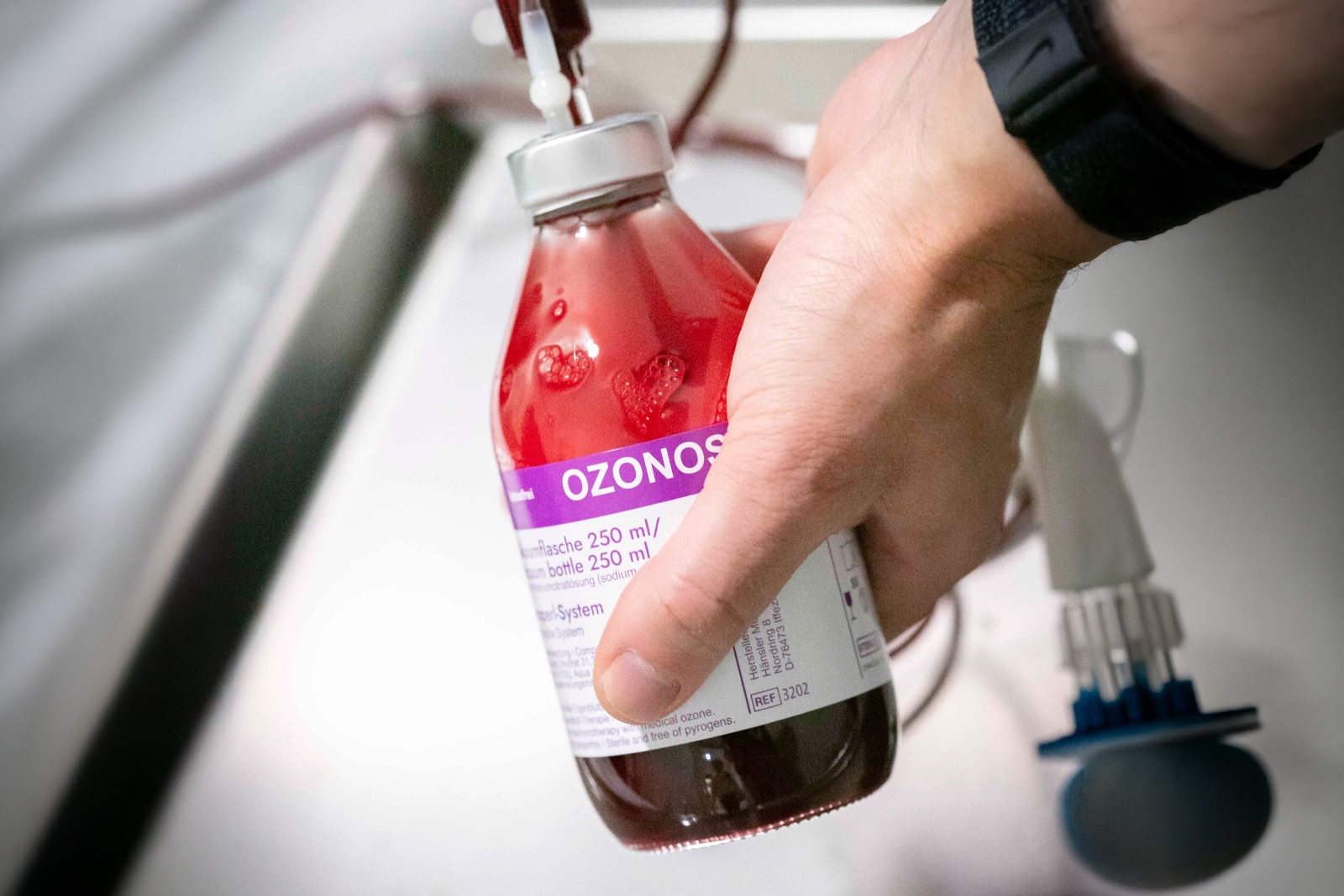
- It does not involve breathing ozone or injecting it into a vein as a gas. The patient’s blood is drawn, treated outside the body with a mixture of oxygen and ozone and then reinfused intravenously. It is an outpatient procedure lasting about half an hour.
- It is a completely different therapy from local ozone injections, those used for the knee or for disc herniation, which have their own mechanisms, indications and evidence. Here I am talking only about systemic MAH.
- In our centres we use it mainly in longevity medicine pathways and in the modulation of chronic low-grade inflammation; with documented results also in post-viral fatigue from long COVID, fibromyalgia and cardiovascular support.
- Its mechanism is not the oxygenation of the blood, as was long believed, but the activation of Nrf2, the cell’s natural antioxidant system.
- The absolute contraindications are favism (G6PD deficiency), uncompensated hyperthyroidism, pregnancy and recent myocardial infarction.
Why I decided to write this article
People who ask me about MAH in my clinic almost always come with some beliefs already formed and quite a few questions. The most common beliefs are two: “I read about it online” and “a friend had it and feels great”. The questions, on the other hand, are often the right ones, even if confused by years of approximate information.
Over time I have realised that the hardest therapy to explain is not the most complex one, but the one surrounded by the most noise. And around MAH quite a lot of noise has built up: on one side, those who present it as a cure for any ailment; on the other, a backlash of scepticism that ignores a literature that is by now solid and growing.
For several years I have been coordinating the team that performs MAH in our centres, always following a standardised protocol. What you find below comes from just two sources: data published in peer-reviewed journals and what I observe directly in the patients I follow.
Systemic MAH and local ozone therapy: two treatments that are often confused
Talking generically about “ozone therapy” is a bit like talking about “surgery”: very different techniques coexist under the same name. Before even discussing effectiveness, it is therefore worth clarifying what we are talking about.
Local ozone therapy involves injecting the gas directly into the site of the problem: intra-articularly in knee osteoarthritis, or peri-radicularly or intradiscally under CT guidance in lumbar disc herniation. It is usually performed by interventional neuroradiologists or orthopaedists, has its own indications and requires an operating-theatre or radiology setting.
Systemic MAH, which is what I deal with here, is instead a treatment of the patient’s blood carried out outside the body and followed by intravenous reinfusion. It does not act on a single joint but on the whole body, through molecular mechanisms involving the antioxidant system, the immune system and circulation.
In our centres we practise only systemic MAH, integrating it into the longevity medicine pathway. The indications I describe below therefore concern this technique, not local injections.
How a session works
The procedure is simple and repeatable. The doctor draws between 100 and 200 millilitres of blood into a dedicated bag containing anticoagulant, mixes it with an ozone concentration calibrated to the individual case (usually between 20 and 40 micrograms per millilitre) and slowly reinfuses it intravenously. The whole process takes about half an hour.
What never happens: the direct injection of ozone gas into a vein. This is one of the absolute constraints of correct practice in Italy, explicitly reaffirmed by the SIOOT guidelines. Anyone who does otherwise is not performing MAH according to protocol, but a manoeuvre with no scientific basis and potentially risky.
Medical ozone, moreover, is not pure ozone. It is a mixture in which oxygen accounts for 95-97% and ozone for the remaining 3-5%, produced at the time of the session by a certified class IIa device, never stored or bought ready-made.
The mechanism of action, beyond the oxygenation myth
For a long time the effect of MAH was explained by talking about “hyperoxygenation of the blood”. It was a convenient answer to a phenomenon that is in fact more complex, and today we know it only scratched the surface.
When ozone meets plasma it triggers a mild and perfectly controlled oxidative reaction. It is precisely this reaction that activates Nrf2, the main regulator of the cell’s antioxidant defences (Front. Physiol. 2024; ESMED2024).
You can think of Nrf2 as a kind of switch which, once turned on, induces the cell to increase the production of highly effective antioxidant enzymes: superoxide dismutase, catalase, glutathione peroxidase, haem oxygenase-1. These are the same defences that the body struggles to maintain at the necessary levels when it is under prolonged stress.
In longevity medicine this principle has a name, hormesis: a controlled stress that pushes the body to strengthen its own defences. It is the same logic as intermittent fasting, intense physical activity or heat exposure, but applied at a biochemical level and with a dose set by the doctor.
On a clinical level the effects are measurable. Several studies show that MAH significantly reduces the main markers of chronic inflammation, such as IL-6, TNF-α and CRP, and improves the rheological properties of the blood, that is, its ability to flow and deliver oxygen to the tissues (Mol Cell Biochem 2022; Heliyon 2024).
The indications with the strongest evidence
I focus only on the areas in which the literature on systemic MAH is truly consistent and which our team encounters most often. I do not go beyond the available data.
1. Longevity medicine
This is the area that best describes the daily work in our centres. The patient who comes to us for a longevity pathway is usually not a sick person, but someone who prefers to act before problems appear. In this context MAH meets a precise need: to modulate, in a measurable way, the body’s chronic inflammatory state and antioxidant reserve, before decline becomes symptomatic.
A review published in 2025 in Aging Clinical and Experimental Research highlighted the role of oxygen-ozone therapy as an adjuvant in immunosenescence and inflammaging, the chronic low-grade inflammation that accompanies and accelerates biological ageing (PubMed 2025). The work of Bocci, who laid the foundations of the discipline in Italy, already described MAH as a tool for supporting the endogenous antioxidant reserve in the ageing person.
Within a longevity pathway, MAH is never the core of the treatment, but one of the most precise tools for keeping the redox state under control over time, slowing inflammaging and supporting mitochondrial function. This is why we include it regularly in programmes for people whose biological age is more advanced than their chronological age.
2. Long COVID
This is the request that has grown the most in the last three years. I am talking about patients with profound fatigue, difficulty concentrating and poor exercise tolerance that last for months, sometimes years, after recovering from the infection, and who have often already seen several specialists without finding a convincing answer.
The study by Tirelli and colleagues (Eur Rev Med Pharmacol Sci 2021), conducted on 100 patients with post-viral fatigue, reported a significant improvement in 67% of cases after ten MAH sessions (Tirelli 2021). A more recent paper, from 2026, confirmed benefits on fatigue, anxiety, mood and sleep quality (Front. Medicine 2026).
Here too we never offer MAH on its own: we include it in a protocol that comprises an assessment of mitochondrial function, targeted supplementation and an overall review of lifestyle.
3. Fibromyalgia
A 2025 study documented, after cycles of MAH, significant reductions in pain, fatigue and sleep disturbances, maintained for up to six months after the end of treatment (J Clin Med 2025).
For a condition such as fibromyalgia, which responds poorly to traditional drugs and usually requires a multi-pronged approach, these are significant data.
4. Cardiovascular and peripheral circulation support
In the study by Giunta and colleagues, 27 patients with La Fontaine stage II-III peripheral arterial disease treated with MAH showed a significant reduction in blood viscosity and fibrinogen (p<0.01), with an improvement in pain when walking (Heliyon 2024). There are also favourable data on the use of MAH as add-on therapy in heart failure with reduced ejection fraction (Buyuklu and colleagues).
How safe it is
The answer is yes, provided it is performed correctly: by a trained doctor, with certified equipment and standardised protocols. In Italy, moreover, these are three conditions regulated by law.
The Madrid Declaration on Ozone Therapy, now in its third edition (2020) and signed by twenty-five scientific associations from twelve countries, classifies MAH as a low-risk procedure. Undesired effects, when they occur, are mild, a feeling of warmth or a passing malaise, and occur in less than 0.7% of sessions (ISCO3 2020).
The protocol we apply at Vyta:
- Mandatory pre-treatment screening (blood count, G6PD, thyroid profile); I personally validate every indication before the team starts the cycle
- Individualised concentrations: no “one size fits all” protocol. The dose is calibrated on medical history, therapeutic goal and response in the first sessions
- Defined and reassessed cycles: 10-15 sessions, 2 per week, with clinical follow-up during the pathway
- SIOOT-certified team, with mandatory continuing education — not a certification obtained once and forgotten
The questions I am asked most often
Can I have MAH if I take anticoagulants? Yes, with some caution and appropriate monitoring. MAH does not interfere directly with coagulation, but in patients on warfarin or the new oral anticoagulants we prefer to agree timing and methods with the treating cardiologist.
After how many sessions are the first results seen? In chronic fatigue and low-grade inflammation, the initial benefit usually appears between the fourth and sixth session. A standard cycle includes ten to fifteen; for longevity-oriented maintenance we then recommend booster cycles every four to six months.
Is it true that WADA has banned it for athletes? Yes. Since 2020 the World Anti-Doping Agency has included MAH among the methods of blood manipulation prohibited for professional athletes in competition. It is a point I always clarify with people who practise competitive sport.
What side effects can it cause? In our experience they are limited to mild tiredness in the hours following the first session and, more rarely, a passing feeling of dizziness. When protocols are followed we have not observed serious events.
Who cannot undergo MAH? The absolute contraindications are: favism (G6PD deficiency), uncompensated hyperthyroidism, pregnancy, recent myocardial infarction, active bleeding and allergy to ozone. Preliminary screening serves precisely to identify these cases before starting.
And for knee pain or disc herniation? In those situations local ozone therapy techniques are used, such as intra-articular injection or CT-guided peri-radicular injection, which are procedures different from MAH and require specific operators and settings. We do not perform them in our centres: when a patient needs them, we refer them to neuroradiologist or orthopaedic colleagues.
How we include it in the clinical pathway
In longevity medicine there are no shortcuts, and personally I distrust anyone who promises them.
In the pathway I have developed together with the team, MAH is one of the tools we use to rebalance chronic oxidative stress, contain low-grade inflammation and support mitochondrial reserve, three of the processes that the most recent research places at the centre of accelerated ageing.
We always offer it within a plan built around the individual person, which includes metabolic assessment, a nutritional profile, a physical activity programme and, when indicated, bioidentical therapies. Never as an isolated intervention, and never as an answer that suits everyone.
Whether MAH may have a role in an individual case is an assessment that only makes sense after examining the person’s medical history, tests and goals. An article like this one is meant to explain and to guide; the decision, if any, comes later, in a direct discussion with the doctor.
Dr. Umberto Carraro
Medical Doctor and Surgeon · Longevity Medicine Expert · Founder of VYTA Longevity
Umberto Carraro is a medical doctor and surgeon specialising in longevity medicine. He founded VYTA Longevity, a network of centres dedicated to preventive medicine and the medicine of ageing located in Abano Terme, Milan and Rome, with the aim of making the most up-to-date longevity medicine protocols accessible, based on biomarkers, clinical personalisation and therapies with a solid scientific basis. He personally oversees the design of every treatment pathway and coordinates the medical team of the centres.
Scientific sources cited
- Tirelli U. et al. Fatigue in post-acute sequelae of SARS-CoV-2 (PASC) treated with oxygen-ozone autohemotherapy. Eur Rev Med Pharmacol Sci 2021. Link
- Efficacy of major ozone autohemotherapy in patients with post-COVID syndrome. Front Med 2026. Link
- Short- and medium-term effects of major ozone therapy on fibromyalgia. J Clin Med 2025. Link
- Oxygen-ozone therapy for myocardial ischemic stroke and cardiovascular disease, review. Heliyon 2024. Link
- Oxygen-ozone therapy for reducing pro-inflammatory cytokines. Mol Cell Biochem 2022. Link
- Oxygen-ozone adjunct therapy in aging and senescence-related disorders. Aging Clin Exp Res 2025. Link
- Schwartz A. et al. Ozone Therapy: A Breakthrough in Medical Treatments, Nrf2 mechanism. ESMED 2024. Link
- Madrid Declaration on Ozone Therapy, 3rd edition. ISCO3, 2020. Link
- SIOOT — Italian Society of Oxygen-Ozone Therapy. Link
This article is for information purposes only. It does not replace individual medical advice.