Precision medicine, prevention and longevity: towards a new health paradigm.
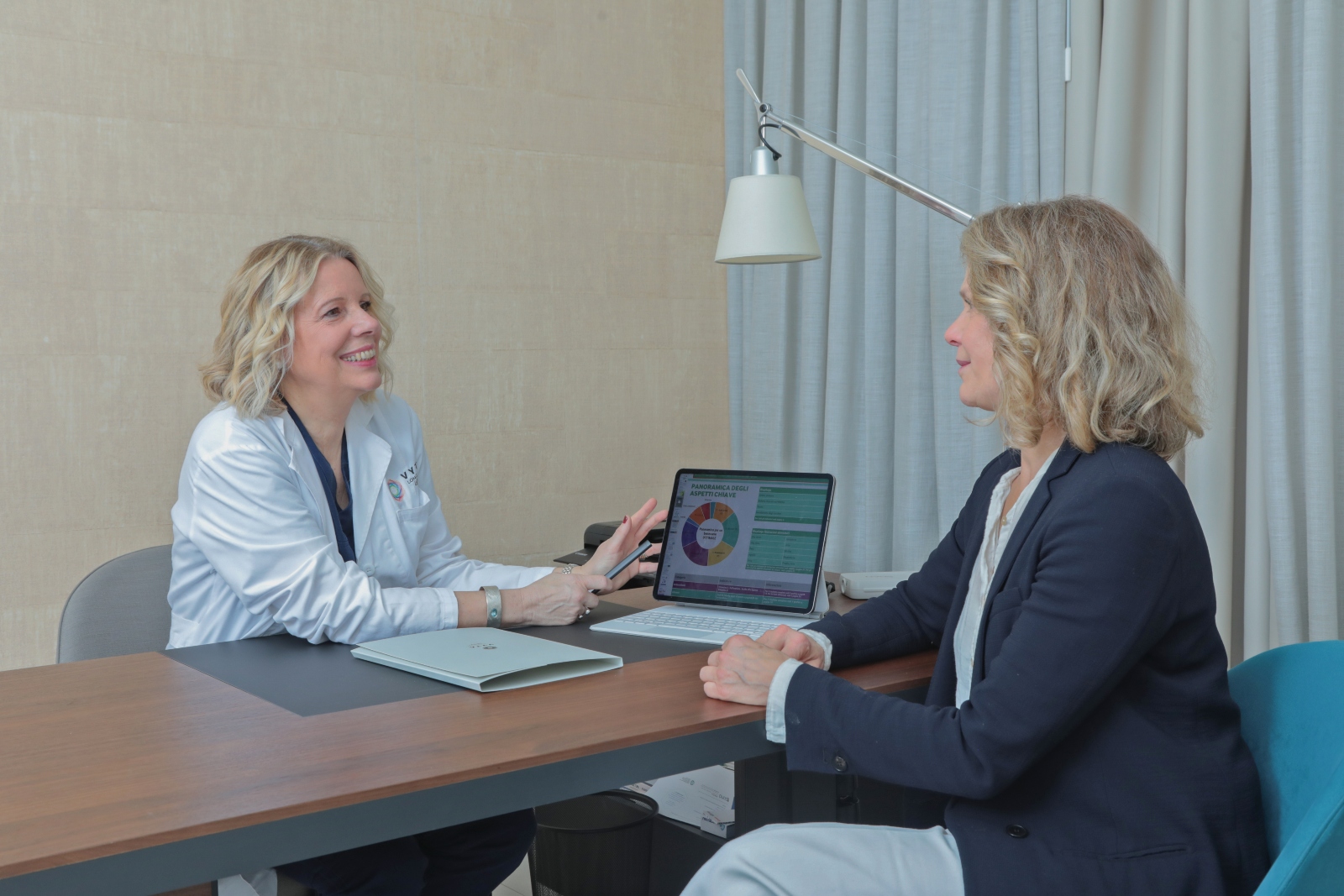
From treating disease to building health.
Introduction
What is Precision Medicine and why is it considered the new medicine?
Medicine is undergoing a profound transformation. For years, the classic approach to medicine was based on the doctor’s ability to recognise a disease process already under way and to act accordingly to treat it. In this sense, we have always spoken of Curative Medicine. Today this paradigm appears insufficient.
While the twentieth century saw extreme specialisation, which identified the patient with an anatomical part or organ, forgetting the person as a whole, in recent years there has been renewed attention to the concept of the person as a psycho-physical unit, the result of the interaction between genomic components and the surrounding environment. These elements are the premise for a Medicine of the Person.
Anti-ageing preventive medicine fits into this context because it brings back the holistic model of the patient and, for the first time, adopts the term well-being-wellness, in line with the modern view of primary health, which, as defined by the World Health Organization (WHO), is “a state of complete physical, mental and social well-being and not merely the absence of disease”.
The task of Anti-age medicine, or better, of Precision Medicine, as defined by the WHO in May 2026, is to use clinical, molecular, genomic and other data in an integrated way to guide prevention, diagnosis and treatment taking individual variability into account.
The fundamental shift is therefore from a medicine that asks which disease does this person have? to a medicine that tries to understand what their risks are, what their biological reserves are and which interventions can keep them healthy for longer.
Longevity is not just living longer
The modern concept of longevity should not be identified simply with extending the length of life. The most important goal is to increase what is called healthspan, that is, the number of years lived in good health, with physical autonomy, cognitive abilities, metabolic balance and therefore a good quality of life.
Ageing is in fact a multidimensional process in which genetics, metabolism, the immune system, inflammation, body composition, physical activity, nutrition, sleep, stress, environment and socio-economic conditions interact. On this basis, the WHO considers healthy ageing as the process through which functional ability and the conditions that allow a person to live well in old age are maintained over time.
This also radically changes the meaning of prevention.
It is no longer just about avoiding a single disease, but about preserving the body’s ability to adapt, compensate and maintain its function over time.
From standard prevention to personalised prevention
Traditional prevention is based mainly on recommendations that apply to the general population: periodic check-ups, vaccinations, physical activity, a balanced diet, control of blood pressure, lipids and blood sugar, cancer screening.
These interventions remain fundamental.
Precision medicine, however, adds a further level: the possibility of tailoring prevention on the basis of the individual risk profile.
Chronological age, family history and lifestyle can be integrated with clinical information, metabolic parameters, genomic data, biomarkers, body composition, cardiovascular characteristics, cognitive function and, in the future, indicators of biological ageing.
The question therefore becomes not only what should I check at my age?, but rather: what are the main factors determining my future risk and which of them can I act on today?
One of the most significant examples of precision medicine is Gender Medicine.
The Italian National Institute of Health (ISS) has defined Gender Medicine as medicine tailored to each person, taking into account sex and gender differences in epidemiology, clinical manifestations, prognosis and response to treatment. In 2018, the approval of Law no. 3 definitively introduced the concept of gender into the Italian National Health Service.
Gender Medicine therefore represents a crucial dimension of contemporary medical practice: it aims to analyse how biological and socio-cultural differences between men and women influence the manifestation of diseases, the response to treatment and the clinical course. Integrating this perspective is essential to ensure appropriateness in patient care and treatment, improving health outcomes and reducing inequalities.
In this context, Gender Medicine is not only a scientific innovation, but an ethical and social imperative for fairer and more personalised healthcare.
The role of biological age
One of the most interesting concepts in longevity medicine is the distinction between chronological age and biological age.
Two people of the same age may have very different levels of cardiorespiratory fitness, muscle mass and strength, metabolism, inflammation, cognitive function and cardiovascular risk.
Research is trying to identify biomarkers capable of describing these differences and of monitoring individual ageing trajectories.
Here, however, it is important to avoid easy simplifications: no single test is currently able to define a person’s biological age completely and definitively.
Ageing is a complex and multidimensional phenomenon. This is why precision medicine should use integrated panels of information, interpreted in the individual clinical context, rather than relying on a single biomarker.
Data as the new frontier of prevention
Precision medicine is born from the integration of large amounts of data. Genomics, proteomics, metabolomics, epigenetics, the microbiome, imaging, cardiovascular parameters, body composition, physical activity and data from digital devices can all help build a dynamic representation of a person’s state of health.
Precision medicine works to obtain a dynamic risk map, capable of highlighting early deviations from the individual’s health trajectory.
Preventing pathological ageing
Physiological ageing does not coincide with disease. The problem is the progressive loss of functional reserve, which can increase vulnerability to cardiovascular, metabolic, neurodegenerative and oncological diseases.
The speed at which we age is highly epigenetic.
What we call “old age” is an increasingly slower response to environmental challenges.
The exposome, that is, the set of exposures we are subject to, is a fundamental concept for our health in general.
The biological mechanisms studied include chronic low-grade inflammation, metabolic alterations, cellular senescence, mitochondrial dysfunction, immune alterations and the loss of the ability to maintain homeostasis.
Inflammaging, a chronic, systemic, low-grade inflammatory state associated with ageing, is considered one of the possible points of convergence of numerous biological processes related to the diseases of old age.
This does not mean that it is necessary to intervene pharmacologically on every mechanism of ageing. On the contrary, the most rational approach remains to identify the main risk determinants early and to act first and foremost on modifiable factors.
Lifestyle remains the most powerful precision medicine
Paradoxically, technological progress does not reduce the importance of fundamental preventive strategies. Regular physical activity, strength training, a balanced diet, adequate protein intake, maintaining a favourable body composition, good-quality sleep, not smoking, moderate alcohol consumption, and control of blood pressure and metabolic risk factors remain fundamental elements for healthy longevity.
The difference lies in the way these interventions can be prescribed.
Physical exercise, for example, should not be considered simply as a generic recommendation, but as a genuine personalised therapy, tailored to cardiorespiratory capacity, muscle strength, age, comorbidities, goals and individual response.
The same applies to nutrition.
The future direction is therefore the personalisation of prevention strategies, without abandoning what has already been shown to be effective at population level.
The European Observatory on Health Systems and Policies stresses that personalised medicine can contribute not only to more targeted treatments, but also to prevention and to a more appropriate selection of therapeutic strategies; at the same time, it requires infrastructure, training, responsible data management and public trust.
The real innovation, therefore, will not be having more tests, but having the right tests for the right person and using them to make better clinical decisions.
A new model: from the check-up to a pathway towards health
The traditional check-up tends to take a snapshot of the state of health at a given moment. Longevity medicine should instead try to describe a trajectory.
It is not enough to know whether a person has normal blood sugar today. It is useful to understand how metabolism, body composition, blood pressure, fitness, muscle strength and other indicators are changing over the years.
Likewise, it is not enough to know that a person does not have cardiovascular disease today. It is necessary to estimate future risk and to intervene before the damage becomes irreversible.
The real shift from reactive medicine to preventive precision medicine depends on these transformations.
Longevity as a health project
Longevity should not be seen as a promise of indefinitely prolonged life, nor as a race in search of miraculous biomarkers or supplements. It is rather a clinical project aimed at maximising the years lived in good health, reducing as much as possible the period of frailty and dependence.
The “life course” perspective proposed by the WHO goes precisely in this direction: health in old age is built over the whole lifespan through the interaction of biological, behavioural, environmental and social factors.
Prevention, therefore, should not begin when the first signs of disease appear, but much earlier.
Conclusions
Precision medicine, prevention and longevity are three aspects of the same change, which is first and foremost cultural.
The medicine of the future will not only be a medicine able to treat diseases better, but a medicine able to anticipate them, identifying risk factors early and intervening on the individual health trajectory.
The real revolution therefore does not consist simply in living longer, but in being able to maintain function, autonomy, cognitive ability and quality of life for longer.
Precision medicine can provide the tools to better understand individual variability; prevention can turn this knowledge into concrete interventions; longevity medicine can provide the final goal: increasing healthspan, reducing as much as possible the years lived with disease and frailty.
The future of medicine could be summed up in one slogan:
don’t wait for disease to appear in order to treat it, but know the person well enough to be able to intervene before disease appears.
It is precisely in this space – between biological data, prevention, lifestyle and personalised clinical decisions – that a new medicine is emerging: a medicine oriented not only towards treatment, but towards building and preserving health throughout life.
Reference scientific literature
For a general overview:
Galimberti D., La Medicina dell’Aging e dell’Anti-aging, Milano, Edra 2016
Precision medicine
Collins FS, Varmus H. A New Initiative on Precision Medicine.
New England Journal of Medicine, 2015; 372(9): 793-795.
Healthspan vs Lifespan
López-Otín C, Blasco MA, Partridge L, Serrano M, Kroemer G. The Hallmarks of Aging.
Cell, 2013; 153(6): 1194-1217.
Updated version (2023)
López-Otín C, Blasco MA, Partridge L, Serrano M, Kroemer G. Hallmarks of Aging: An Expanding Universe.
Cell, 2023; 186(2): 243-278.
Inflammaging
Franceschi C, Campisi J. Chronic inflammation (inflammaging) and its potential contribution to age-associated diseases.
The Journals of Gerontology: Series A, 2014; 69(Suppl 1): S4-S9.
Biological age and biomarkers
Franceschi C, Campisi J. Chronic inflammation (inflammaging) and its potential contribution to age-associated diseases.
The Journals of Gerontology: Series A, 2014; 69(Suppl 1): S4-S9.
Gender Medicine
ISS (Italian National Institute of Health) documents — Plan for the application and dissemination of Gender Medicine: https://www.iss.it/medicina-di-genere
On the Exposome
Wild CP. Complementing the genome with an “exposome”: the outstanding challenge of environmental exposure measurement in molecular epidemiology.
Cancer Epidemiology, Biomarkers & Prevention, 2005; 14(8): 1847-1850.
“Life Course” perspective (WHO)
WHO – World Report on Ageing and Health, 2015 (official WHO document): https://www.who.int/publications/i/item/9789241565042
This article is for information purposes only. It does not replace individual medical advice.