VO2max: why the ability to use oxygen is one of the best indicators of longevity
In brief
- VO2max measures how much oxygen the body can use during exertion: it is a snapshot of how the heart, lungs, blood and muscles work together.
- It is one of the most robust predictors of how long and how well we will live: people with higher aerobic capacity have, on average, a considerably lower risk of mortality.
- VO2max starts to decline around the age of 35, and below a certain threshold everyday activities become tiring.
- It can be improved at any age, even when starting late.
- The most accurate way to measure it is the cardiopulmonary exercise test; smartwatches only give an estimate.
Why I decided to write this article
In recent years VO2max has left sports medicine laboratories and entered everyday language. Wristwatches display it, longevity podcasts talk about it, and many patients come to their visit with a screenshot and a question: “Is this number good?”.
It is a curiosity I find positive, because it really is one of the most important parameters we can measure. Along with curiosity, however, has come a lot of noise: numbers taken out of context, excessive promises, suggestive but imprecise comparisons. I wanted to write this article to bring some order, in simple words, and to explain why in our Longevity Pathway we give VO2max a central place.
What VO2max is
Every cell in our body needs oxygen to produce energy. During exertion the demand increases, and the body has to take more oxygen from the air, carry it in the blood and deliver it to the working muscles. VO2max is the maximum amount of oxygen we are able to use in this way.
I like to explain it to patients as the engine size of a car. It does not tell you how fast you are going at a given moment, but how much margin you have when you need to push: running up the stairs, carrying the shopping bags, coping with an illness or a surgical operation.
It is expressed in millilitres of oxygen per kilo of body weight per minute (mL/kg/min). Studies often use another unit as well, the MET. One MET is the energy expenditure when sitting quietly; a 5-MET activity requires five times that energy. To convert from one to the other, simply divide by 3.5: a VO2max of 35 mL/kg/min equals 10 METs.
Why it matters so much for health
Of all the parameters we measure in a prevention visit, few are backed by such a large body of data. A large review published in 2024 pooled studies on more than 20 million people and found that each additional MET of aerobic capacity is associated with a reduction in the risk of death of between 11 and 17%. Fitter people also suffer less from heart failure, diabetes, depression and dementia.
A Cleveland Clinic study of more than 120,000 people showed that those with the highest aerobic capacity had a mortality risk about 80% lower than those with the lowest. No “ceiling” was observed beyond which the benefit stops.
This is why the American Heart Association proposes considering cardiorespiratory fitness a true vital sign, on a par with blood pressure and heart rate, and suggests that all adults have it assessed at least once a year.
In fairness, I must add that these are observational studies: they show a very strong and consistent link, but on their own they do not prove that fitness alone is protective. Fit people also tend to have other good habits, and part of VO2max depends on genetics. It remains, however, one of the few major risk factors we can act on directly.
What happens with age
VO2max does not stay still. A Swedish study that followed the same people for almost fifty years observed that physical capacity begins to decline as early as around the age of 35, and that the decline becomes more marked over time. On average, about 10% is lost per decade, with an acceleration after the age of 70.
The point I care about most as a longevity doctor is this: there is a threshold below which everyday life becomes difficult. When VO2max falls to around 18 mL/kg/min in men and 15 in women, independence begins to be at risk. In the general population this happens on average between the ages of 80 and 85.
That is why I often say that the VO2max we build at 50 is the reserve we will live on at 80. Starting higher means having more years of margin before approaching that threshold.
Can it be improved? Yes, at any age
This is the most encouraging part. VO2max is one of the parameters that responds best to training. In the same Swedish study, those who had become active in adulthood, even when starting late, had improved their physical capacity by 5-10%. And every step forward counts: the data show that even an improvement of a single MET is accompanied by a reduction in risk.
For those starting from scratch, the reference is the World Health Organization’s guidance: at least 150-300 minutes a week of moderate aerobic activity, such as brisk walking or cycling, or 75-150 minutes of more intense activity, plus strength exercises at least twice a week. Those who are already trained can add interval sessions, alternating short intense phases and recovery phases, which are particularly effective for raising VO2max.
Before increasing intensity, especially after the age of 40-50 or in the presence of cardiovascular risk factors, it is good practice to have a medical assessment.
How it is measured
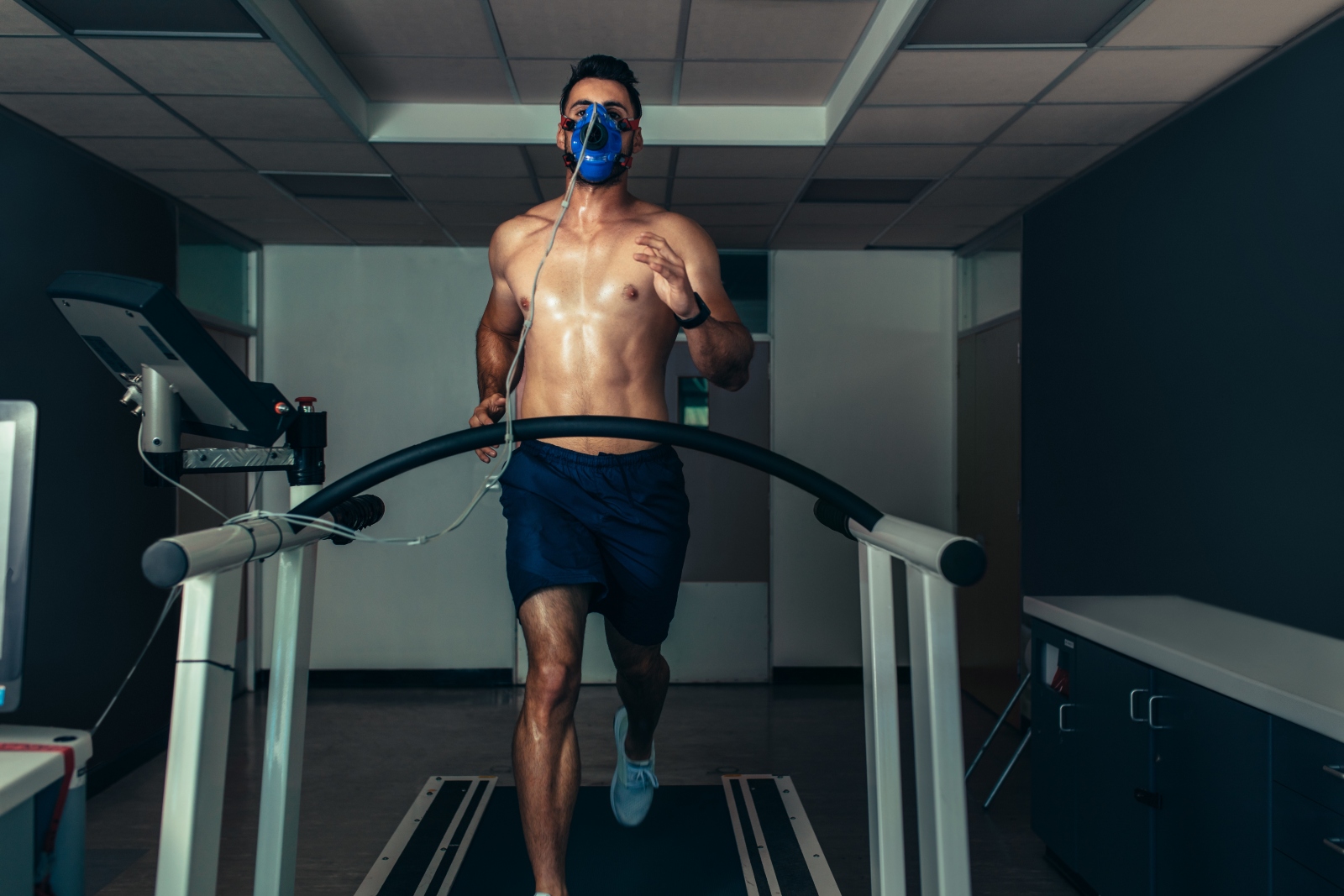
The reference method is the cardiopulmonary exercise test. You pedal on an exercise bike or walk on a treadmill with an effort that gradually increases, while wearing a mask that analyses the air you breathe. In this way VO2max is not estimated with a formula, but measured directly.
The test also provides another valuable piece of information: the thresholds at which our body changes the way it produces energy. Knowing them makes it possible to build tailored training, with intensity zones based on one’s own physiology rather than on generic tables.
Smartwatches, on the other hand, estimate VO2max from heart rate and speed. They are useful for following the trend over time, but the number can differ by several points from the real value: a 2025 study found that a popular watch model underestimated VO2max by about 6 mL/kg/min on average. It may not seem much, but it is the difference between “average” and “above average”.
Three beliefs to put into perspective
It is often said that being unfit is worse than smoking. The reality is more nuanced, but no less important: having below-average aerobic capacity weighs on risk as much as smoking or diabetes.
It is also said that high-intensity training “extends life”. The only large study that tested this directly, on about 1,500 seventy-year-olds followed for five years, gave an encouraging signal, but not yet definitive proof.
Finally, the number on your watch is not a diagnosis. It is a good reminder, not a measurement.
Who should have it measured
It can be useful, for example, for those who are over forty, have been sedentary for some time and have some risk factor such as slightly high blood pressure: the test shows where you are starting from and offers a concrete goal to check after a few months.
It is also useful for those who train regularly but do not know whether they are doing it the right way, as often happens to women after menopause: knowing your thresholds lets you train better, not more.
And it makes sense for those who, past the age of sixty-five, want to stay independent for as long as possible: knowing how much margin you have relative to the independence threshold is information that guides the choices of the coming years.
VO2max in the VYTA Longevity Pathway
In our Longevity Pathway, the assessment of VO2max is part of the specialist visits and is carried out with a cardiopulmonary exercise test and analysis of respiratory gases. We do not consider it an isolated number: we read it together with the other parameters of the pathway, compare it with the expected values for age and sex and use it to build a personalised training programme. Repeated over time, it tells us whether the work done is really moving the indicator in the right direction.
The questions I am asked most often
What is a good VO2max value?
It depends a great deal on age and sex, which is why comparison with your peers matters more than the absolute number. As a reference, in international data the average value for a twenty-year-old is around 50 mL/kg/min in men and 40 in women, while after the age of 70 it falls to around 30 and 25.
What is a MET?
It is a unit that expresses the intensity of an effort as a multiple of resting consumption. One MET equals 3.5 mL/kg/min of oxygen: to convert VO2max into METs, simply divide it by 3.5.
Can VO2max be increased after 60?
Yes. Aerobic capacity remains trainable even in old age. All it takes is an initial assessment and a gradual progression.
Is my smartwatch’s VO2max reliable?
It is useful for seeing whether you are improving or getting worse over time, but the absolute value may be several points away from the real one.
Is the cardiopulmonary exercise test tiring?
It requires real effort, because you need to reach your maximum, but it lasts a few minutes, the effort increases gradually and the test takes place under medical supervision.
Sources
- Lang JJ et al. Cardiorespiratory fitness is a strong and consistent predictor of morbidity and mortality among adults. Br J Sports Med 2024. Link
- Kodama S et al. Cardiorespiratory fitness as a quantitative predictor of all-cause mortality and cardiovascular events in healthy men and women. JAMA 2009. Link
- Mandsager K et al. Association of cardiorespiratory fitness with long-term mortality among adults undergoing exercise treadmill testing. JAMA Netw Open 2018. Link
- Kokkinos P et al. Cardiorespiratory fitness and mortality risk across the spectra of age, race, and sex. J Am Coll Cardiol 2022. Link
- Kokkinos P et al. Changes in cardiorespiratory fitness and survival in patients with or without cardiovascular disease. J Am Coll Cardiol 2023. Link
- Ross R et al. Importance of assessing cardiorespiratory fitness in clinical practice: a case for fitness as a clinical vital sign. Circulation 2016. Link
- Westerståhl M et al. Rise and fall of physical capacity in a general population: a 47-year longitudinal study. J Cachexia Sarcopenia Muscle 2025. Link
- Fleg JL et al. Accelerated longitudinal decline of aerobic capacity in healthy older adults. Circulation 2005. Link
- Shephard RJ. Maximal oxygen intake and independence in old age. 2009. Link
- Kaminsky LA et al. Development of global reference standards for directly measured cardiorespiratory fitness (FRIEND). Mayo Clin Proc 2019. Link
- Milanović Z et al. Effectiveness of high-intensity interval training and continuous endurance training for VO2max improvements. Sports Med 2015. Link
- Stensvold D et al. Effect of exercise training for five years on all cause mortality in older adults: the Generation 100 study. BMJ 2020. Link
- Lambe R et al. Investigating the accuracy of Apple Watch VO2 max measurements: a validation study. PLoS One 2025. Link
The information in this article is for educational purposes and in no way replaces the advice of a doctor. The cardiopulmonary exercise test is a medical examination: it requires a visit and an assessment of fitness for exertion. No intensive training programme should be started on the basis of what is read here without consulting your own doctor.