

CARDIORESPIRATORY & METABOLIC FUNCTION
The engine of LONGEVITY
Cardiorespiratory fitness and metabolic efficiency are fundamental pillars of health and longevity.
These two systems work in constant synergy: the lungs and heart capture oxygen and deliver it to the tissues, where mitochondria use it to turn nutrients (carbohydrates and fats) into energy. When this mechanism falters because of a sedentary lifestyle, aging or subclinical problems, the body experiences an energy slump, reduced exercise tolerance and a higher risk of cardiometabolic disease.
To map these dynamics precisely and optimize health, modern functional diagnostics relies on high-level, non-invasive methods.
Knowing your cardiometabolic efficiency lets you move beyond generic protocols and build tailored training, therapy and nutrition plans that boost your body’s energy engine.
TEST
VO₂ Max
Your maximum ability to use oxygen during exercise is one of the strongest predictors of health and life expectancy.
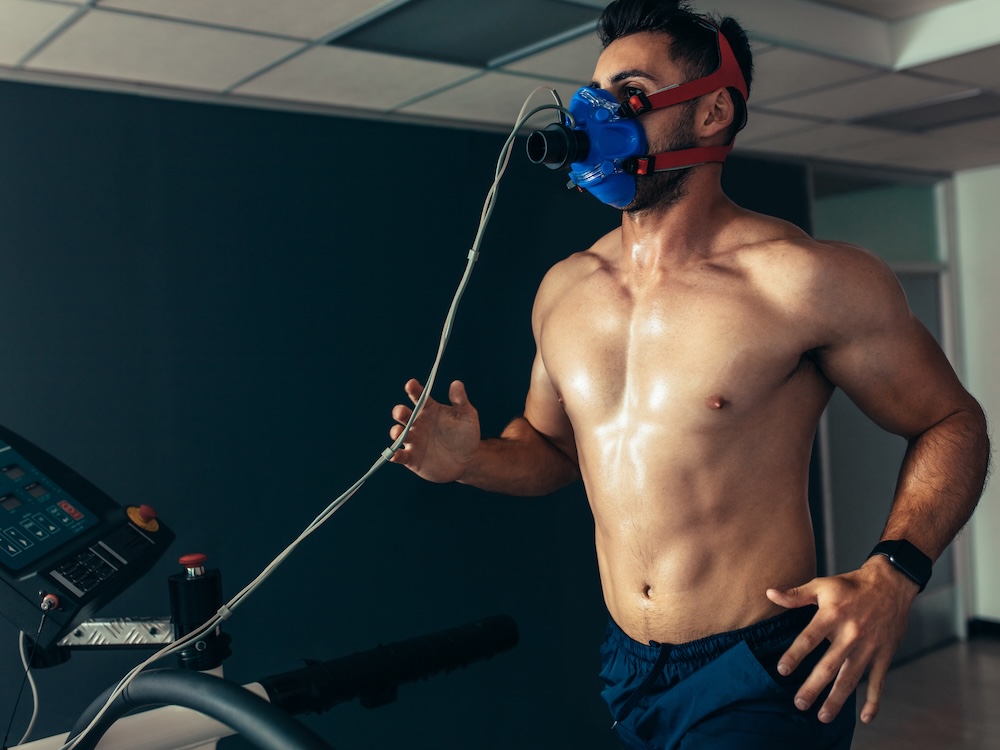
The VO₂ max test scientifically measures cardiovascular efficiency, aerobic performance and your body’s response to exercise, making it possible to design truly personalized training programs.
PURPOSE OF THE TEST: To assess the efficiency of the cardiovascular and muscular systems, establish the athlete’s physical limits and monitor training-induced progress over time.
WHAT IT IDENTIFIES: Peak aerobic power, ventilatory thresholds (aerobic and anaerobic) and ideal heart rate zones to personalize training intensity.
WHO IT IS FOR: Professional and amateur athletes (especially in endurance sports such as running, cycling and triathlon), as well as people who want to optimize their fitness or monitor their cardiovascular health.
HOW IT IS PERFORMED: In the laboratory, with an incremental maximal exercise test on a cycle ergometer. You wear a face mask connected to a metabolic cart that analyzes exhaled gases (oxygen and carbon dioxide).
TEST
CARDIOPULMONARY EXERCISE TEST (CPET)
The cardiopulmonary exercise test (CPET) is a non-invasive diagnostic test that assesses the integrated response of the cardiac, pulmonary, metabolic and muscular systems during exercise. It simultaneously monitors the electrocardiogram (ECG) and respiratory gases.
PURPOSE OF THE TEST: To measure exercise tolerance, diagnose the causes of unexplained shortness of breath (dyspnea) and determine whether the physical limitation is cardiac, pulmonary or muscular in origin.
WHAT IT IDENTIFIES: Abnormal ventilation, latent myocardial ischemia, abnormal blood pressure responses and key parameters such as peak oxygen uptake (VO₂ peak) and the anaerobic threshold in a clinical setting.
WHO IT IS FOR: Patients with heart failure or lung disease, people facing major surgery (risk assessment), people who experience symptoms during exercise, and athletes needing in-depth clinical sports assessments.
HOW IT IS PERFORMED: You pedal on a cycle ergometer with a progressively increasing workload, wearing a face mask for gas analysis and electrodes for continuous ECG, while blood pressure is also constantly monitored.
TEST
EXERCISE STRESS TEST (EXERCISE ECG)
The classic exercise stress test (also known as an exercise ECG or ergometric test) is a cardiovascular diagnostic test that continuously records the electrocardiogram (ECG) and monitors blood pressure while you perform controlled, progressive physical work.
PURPOSE OF THE TEST: To assess the health of the heart under a high workload, identifying abnormalities that may not appear at rest and checking your overall exercise tolerance.
WHAT IT IDENTIFIES: Myocardial ischemia (reduced blood flow caused by blocked arteries), exercise-induced arrhythmias, abnormal blood pressure responses and any symptoms such as chest pain or shortness of breath.
WHO IT IS FOR: People with cardiovascular risk factors (high blood pressure, high cholesterol, smoking), patients with known heart disease (for periodic check-ups) and anyone who needs a medical certificate for competitive sports (required in Italy).
HOW IT IS PERFORMED: You pedal on a cycle ergometer following a protocol with increasing workloads. Electrodes on the chest record the ECG in real time, while a cuff monitors blood pressure at regular intervals until maximum effort is reached.
TEST
INDIRECT CALORIMETRY (RESTING METABOLIC RATE)
Every body uses energy differently. Indirect calorimetry is a non-invasive instrumental test that measures resting energy expenditure (basal metabolic rate), providing objective data to build highly personalized nutrition plans and weight-management strategies. An essential step to
optimize body composition and metabolic performance and to prevent metabolism-related diseases.
PURPOSE OF THE TEST: To determine with scientific precision how many calories your body burns over 24 hours at rest, going beyond the rough estimates of mathematical formulas.
WHAT IT IDENTIFIES: Your resting metabolic rate (REE/BMR) in kilocalories and your respiratory quotient (RQ), a parameter that shows the proportion of carbohydrates and fats your body is burning as fuel at that moment.
WHO IT IS FOR: People who struggle to lose or gain weight, those with metabolic disorders, athletes who need a precise nutrition plan, and, in clinical settings, patients on artificial nutrition or with severe obesity.
HOW IT IS PERFORMED: After fasting for 4–12 hours, you lie down or sit in a comfortable, temperature-controlled room and breathe normally for about 15–20 minutes inside a transparent hood (canopy) or through a mouthpiece or mask connected to a metabolic cart.
TEST
SPIROMETRY
Spirometry is a lung function test that assesses lung capacity, airflow and the quality of ventilation during inhalation and exhalation. Put simply, it measures how much air your lungs can hold and how quickly that air can be breathed in and out.
PURPOSE OF THE TEST: To assess lung health, detect respiratory changes early, monitor known conditions and fully evaluate lung function from a preventive, sports and longevity medicine perspective.
WHAT IT IDENTIFIES: Key parameters such as forced vital capacity (FVC) and forced expiratory volume in 1 second (FEV1), identifying respiratory deficits and the presence of asthma, COPD or pulmonary fibrosis.
WHO IT IS FOR: Smokers and former smokers, people with symptoms such as chronic cough, shortness of breath (dyspnea) or wheezing, workers exposed to dust or chemicals, and athletes needing sports fitness certification.
HOW IT IS PERFORMED: Seated, with a nose clip to block nasal airflow, you seal your lips around the mouthpiece of a spirometer. You then take a deep breath in, followed by a maximal breath out, as fast and as forcefully as possible.
TEST
SPIROMETRY WITH DLCO
In the DLCO version (diffusing capacity of the lungs for carbon monoxide), spirometry goes further by measuring alveolar-capillary diffusion capacity, a key parameter for understanding how efficiently gases are exchanged between the lungs and the blood.
PURPOSE OF THE TEST: To check how effectively oxygen passes from the lung alveoli into the blood capillaries, measuring the integrity and function of the respiratory membrane.
WHAT IT IDENTIFIES: Impaired gas exchange, revealing early structural damage to lung tissue, loss of capillary surface area or thickening of the alveolar-capillary membrane.
WHO IT IS FOR: Patients with suspected or known pulmonary fibrosis, emphysema, COPD, pulmonary hypertension or autoimmune diseases affecting the lungs, and people with persistent, unexplained shortness of breath (dyspnea).
HOW IT IS PERFORMED: You breathe through a mouthpiece. After fully emptying your lungs, you take a deep breath of an air mixture containing tiny, harmless traces of carbon monoxide and a tracer gas, hold your breath for 10 seconds and then breathe out quickly for gas analysis.
A preliminary consultation with one of our physicians will help you choose the most suitable test.
Book a visit and take the test at our clinic.